The Empty Chair in the IV Lounge: Walk-In Demand Meets the 18% No-Show
IV therapy lounges run on perishable chair-hours and an 18% no-show baseline. The slot backfill math that turns same-day cancellations into same-day revenue.
Ed
biohacking and longevity, NAD+ IV therapy, IV lounge, cancellation recovery, AI receptionist, Aurora, pillar 2
General information for practice owners, not medical, legal or tax advice.
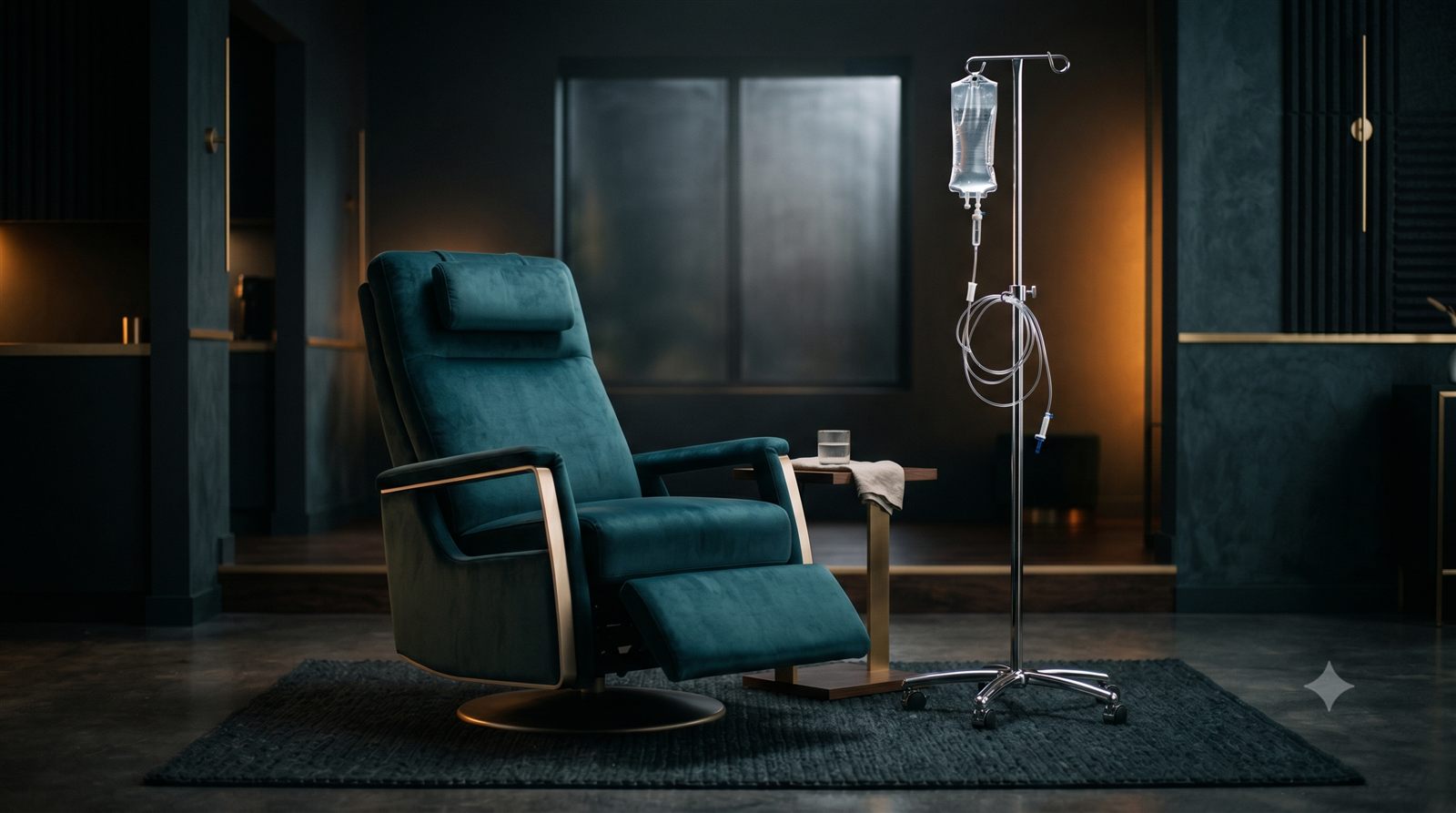
An IV therapy chair is the most perishable inventory in the longevity business. A hormone consult can slide a week. A panel review can move to Thursday. But a 2 p.m. infusion slot that goes empty at 1:40 is gone — the chair, the nurse-hour, and the revenue all expire together at 3 p.m. and cannot be sold retroactively. Lounge economics are airline economics: the seat flies whether or not someone is in it.
The Thinking Robot installs Revenue Recovery Infrastructure for high-value practices, with Aurora, our AI intake assistant for longevity, hormone and vitality practices (not a clinician), handling intake for biohacking and longevity practices. This post is about the specific arithmetic of the empty chair — and the strange advantage IV lounges hold over every other practice type that suffers no-shows.
The Demand Is Real. The Schedule Is the Problem.
The category is growing on every measure. The NAD+ IV clinics market reached roughly $512 million in 2025 and is projected to roughly double by 2032 at a 10.8% CAGR, riding the broader IV hydration boom. Session pricing runs $99 to $299 for standard formulations, with NAD+ protocols and add-on pushes lifting individual tickets well past that — NAD+ infusions commonly price in the $300 to $750 range depending on dose and market. Franchise data shows the unit economics work when chairs stay full: DripBar locations average $570,900 in annual revenue.
Against that demand, the leak: healthcare scheduling research puts the baseline no-show rate around 18–19%. In an illustrative model (not a client result), a lounge running 40 booked infusions a week at a blended $220 average loses roughly seven slots weekly to no-shows and same-day cancellations — about $1,540 a week, $80,000 a year, in chair-hours that evaporated. For a lounge with a meaningful NAD+ mix at $400-plus per session, the same seven empty chairs cost over $145,000 a year. And that counts only the no-shows, not the inbound calls that ring out while every staff member has both hands on an IV line.
The Walk-In-Adjacent Advantage
Here is what makes IV lounges different from surgical practices, and why their no-show problem is unusually fixable: the demand is walk-in-adjacent. A meaningful share of customers — the post-flight recovery, the pre-event glow, the Saturday-morning regret — decide they want an infusion today. They are not booking three weeks out. They are calling at 11 a.m. asking what is open this afternoon.
That means every cancellation has a live counter-party somewhere in the market within the hour. The surgical practice that loses a case to a no-show has nobody to put in the OR on forty minutes' notice. The IV lounge almost always does — if, and only if, the lounge can do three things faster than the slot expires:
Catch the cancellation the moment it happens, including the text-message cancellation that arrives while the front desk is starting a line and goes unread for two hours.
Hold a live standby list of people who asked for short-notice openings — members due for their next NAD+ session, regulars who asked about weekend availability, this morning's callers who could not get the time they wanted.
Work the list by voice, immediately. Texts get seen in hours; a same-day slot dies in minutes. An outbound call to someone who opted in to short-notice offers that says "a 2 p.m. chair just opened, do you want it" converts standby demand into a filled chair while the slot is still alive.
Standby offers go only to customers who opted in to short-notice offers. They are informational; every call opens by identifying the AI assistant and noting that the call is recorded, every text carries "Reply STOP to opt out," and no treatment details appear in a text or voicemail. Outbound marketing calls and texts run only to contacts with documented prior express written consent, inside state calling windows, with STOP or any other opt-out honored on every channel.
This is Pillar 2, Cancellation Recovery, tuned for perishable inventory: the Zero-Gap waitlist that backfills openings in minutes, not days. In an illustrative MedSpa model — not a guaranteed result — the same architecture backfills in roughly five minutes — and a MedSpa's demand is less walk-in-adjacent than a drip lounge's.
The Staffing Reality Nobody Says Out Loud
IV lounges run lean by design — typically a nurse or two and sometimes a part-time front desk. When a customer is in a chair, the clinical work is the job; the ringing phone is the interruption. Which means the lounge's two revenue systems, the chairs and the phone, are structurally in conflict every busy hour of the day. The 11 a.m. caller asking about this afternoon — the exact walk-in-adjacent demand that should be backfilling your cancellations — reaches voicemail precisely because the lounge is busy. The busier you are, the more demand you leak.
The fix is not another hire standing by a phone. It is an intake layer built to answer inbound calls live, typically within two rings, that quotes today's real availability, books the slot, sends any deposit request through your own payment channel where your policy requires one, and runs the opted-in standby calls when a chair opens — while your nurses never take a hand off a patient. One compliance note for the longevity-leaning lounge: callers will ask about compounds and protocols that are investigational or outside your scope. The correct front-desk posture is intake-only — capture the interest, book the consult, make no claims about efficacy, dosing, or availability. Build that constraint into any automation before it answers its first call.
Run Your Own Chair Math
Three numbers tell you whether this matters for your lounge: weekly booked sessions, blended average ticket, and your true no-show-plus-late-cancel rate (most operators guess low; pull sixty days of actuals). Multiply them. If the annual figure clears five figures — and at the published 18% baseline it almost always does past 30 sessions a week — then slot backfill is not an operational nicety. It is the highest-margin revenue in the building, because the rent, the nurse, and the chair are already paid for. The only thing missing was the phone call.
References
Stratistics MRC, NAD+ IV Clinics Market — $511.9M (2025) to $1,049M (2032), 10.8% CAGR (strategymrc.com, 2025)
Mordor Intelligence, IV Hydration Therapy Market Size and Outlook 2025–2030 (mordorintelligence.com, 2025)
Kheirkhah et al., Prevalence, predictors and economic consequences of no-shows — 18.8% mean no-show rate (PMC, ncbi.nlm.nih.gov)
The DRIPBaR franchise disclosure data, average unit revenue (thedripbar.com / wolfoffranchises.com, 2025)
Pabau, IV therapy clinic best practices — session pricing and margin benchmarks (pabau.com, 2025)
Next Step
If your premium practice runs more than 100 inbound consult inquiries a month and has no structured measurement of how many never reach a scheduled consultation, your pipeline may be leaking revenue you cannot see. The Line Audit shows you what actually happens: we call your line at the hours you're least likely to answer and send you the recordings with a written breakdown.
Audit Real-Time Conversational Velocity: Talk to Rosey, our AI receptionist, at +1 (720) 776-1664 (an AI demo line; calls are recorded).